The National Oncology Alliance patient rights and roles webinar series – the patient perspective
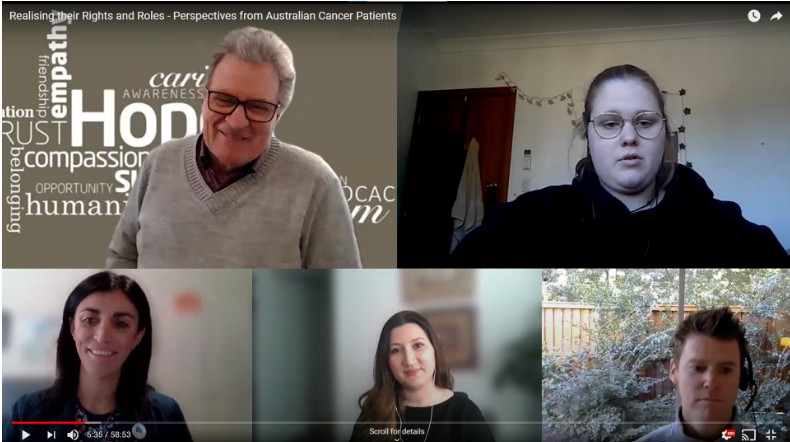
The final webinar in our four-part series on patient rights and roles featured a compelling and remarkable panel of patient and carer advocates – including rare cancer advocate Lisa Briggs, parent and childhood cancer advocate Jelena Magic, advocate and past carer Nick Kelly, and adolescent and young adult rare cancer advocate Tamlin Hall.
Attended by a record audience for our series with more than 160 patients, carers, family members, clinicians and representatives from government, the health system and industry gathering to hear the views of these advocates on Wednesday 4 August, it was a reminder of how powerful the voice and views of those with lived experience can be.
It was a privilege to listen to the honest and deeply personal insights of each panel member, including that of Nick Kelly, advocate and past carer of his wife Nicole, who passed away from a rare salivary gland cancer last year but not before leaving him with the gift of a son, two-year-old Xander.
For Nick, the issue can be seen at the very core of what we are trying to achieve, person-centricity.
“Centricity is defined as a place of central prominence and I think at the crux of it, the challenge here is that often the disease takes the centre place, not the person. I think that’s the challenge that we’re trying to grapple with, and it’s very difficult to devolve the two,” Nick said.
Nick reflects on his journey with his wife, who was an Occupational Therapist in the public health system, and how beneficial this inside knowledge was in helping his family to make decisions. He also raised that many others are not so lucky to have this knowledge guiding them, and the rest of our panel agreed.
“In order to navigate the system, a patient is required to have a really high level of medical, organisational, and information management skills.”
“And at the same time to enable that shared decision-making and then to be an equal partner, patients and families and carers are supposed to be rational when their logical thinking may be impaired due to all the stress associated with diagnosis and everything else that follows,” Jelena Magic, mother of four-year-old Marko who was diagnosed with neuroblastoma, observed.
Jelena shared her experiences and explored how these assumptions within a disjointed system can have significant impacts on the patient and family as a whole.
“That is one of the major issues right now. Everything is so fragmented, and every speciality and every department and every stakeholder, they seem to be working in silos. And then you have these patients who are in the centre and everything is supposed to be about them, but they seem to not have the information to understand what’s happening and how decisions are being made.
“The Australian system is very good at marketing. Before you enter the system you kind of expect that it’s going to be the best system there is because that is the perception. But then once you start learning about it, and especially if you are dealing with something that’s not a common disease, you will start to see those gaps.
“Until we have patients seen as a person that has health needs, but also has social needs, has mental health needs, has financial needs, and that all those parts have to work together in alignment to deliver that person-centred care, until the system is redesigned in such a way (to recognise this), we are always going to feel like something is missing and that we are not being fully informed.”
17-year-old Tamlin echoed these views and highlighted that the common misconceptions around cancer, often perpetuated by the media, can play a very real part in how others understand, approach and include cancer patients in discussions.
“They want to hear the story about how you survived and how you overcame cancer and how you beat it. They don’t want to listen to the nitty gritty parts where you were lying in your bed at 12 o’clock in the morning, crying, thinking that you weren’t going to wake up the next day. They don’t want to hear about how you got stretch marks from putting on 40 plus kilograms from steroids and how you thought if you touch them they would split. They don’t want to hear that,” Tamlin, who was diagnosed with a rare cancer known as blastic plasmacytoid dendritic cell neoplasm at the age of 13, shared.
“They want to see the story of you overcoming this challenge and believe that’s all there is to it, and that all that happens to you is that you lose your hair. But it’s a lot more than that.
“I lost myself when I had cancer and they (people) don’t quite understand that.”
Many on our panel and in the audience expressed how much they related to Tamlin’s views, including rare cancer advocate Lisa Briggs who expanded on this.
“I think it’s that concept of perception versus reality. So we are essentially the players on the field, we’re the ones seeing it, we’re the ones hearing it, we’re the ones living it, and that is such a unique lens that you just can’t find in any other area,” Lisa, mother of two who was diagnosed with a rare form of lung cancer soon after the birth of her second child, said.
“You don’t know what you don’t know right and at the end of the day, everyone is passionate and working hard in the area and industry that they’re in. They think they are doing their best job and that’s their best. But I think it’s up to us to be helping to drive that change, and to be helping to identify those gaps within these organisations and within the system that we’re actually involved in, to ensure we can keep moving forward and not backwards.”
If you would like to view the full webinar, click here:
This is the final webinar in our four-part series on patient rights and roles, if you would like to view the recordings of any other session you can visit our dedicated web page.
Have your say
As part of our research and advocacy work, we want to hear from as many Australians affected by cancer as possible.
In order to capture genuine patient experiences and voices to inform our new research report entitled “Realising the rights and roles of Australian cancer patients”, we would appreciate your input.
You can have your say by completing this short four-minute questionnaire or by emailing your experience to us at [email protected]
By Christine Cockburn