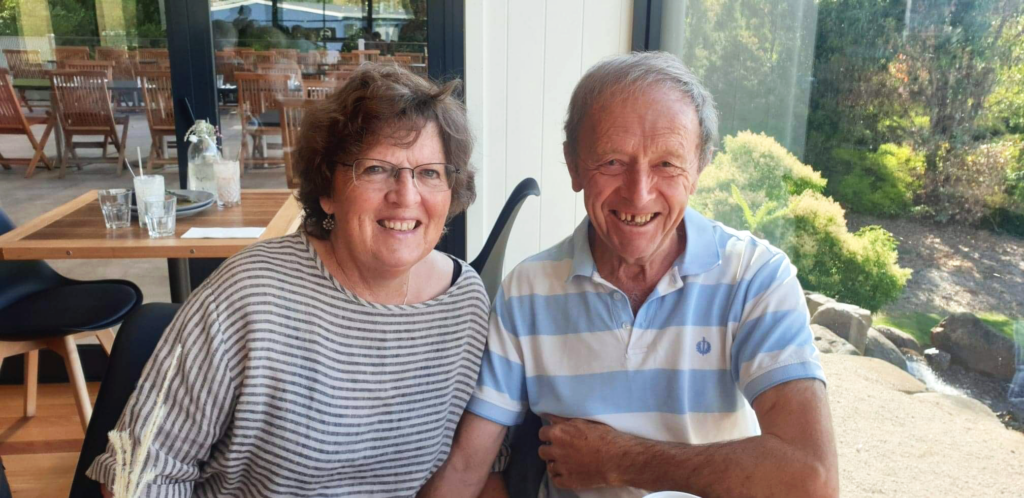
Pam manages to find the positives in her cancera disease where abnormal cells split without control and spread to other nearby body tissue and/or organs experience.
Her treatment currently involves daily tablets, and while the 76-year-old wishes she didn’t have to take them, she’s also relieved she doesn’t have to have chemotherapya cancer treatment that uses drugs to kill or slow the growth of cancer cells, while minimising damage to healthy cells or radiation.
One of the side effects of her treatment has been losing 15 kilograms. Another positive – “everyone tells me how well I look”.
But behind her brave façade, Pam has faced a tough diagnosisthe process of identifying a disease based on signs and symptoms, patient history and medical test results and treatment. Back in 2020, she had open heart surgerytreatment involving removal of cancerous tissue and/or tumours and a margin of healthy tissue around it to reduce recurrence, followed two months later with surgery to remove part of her left lung due to cancer. The back-to-back surgeries have taken a toll on her body, and when Pam felt like she was starting to recover, more cancer appeared on a CT scan, this time in her liver and spine. Alongside this, COVID restrictions also meant Pam was quite isolated during her initial diagnosis and treatment.
“My cancer is very ‘special’, no one has heard of it,” Pam said. Having a rare cancer meant it took a while to diagnose, and Pam’s Tasmanian-based oncologista doctor who specialises in the study, diagnosis and treatment of cancer had to consult with the Peter MacCallum Cancer Centre in Victoria for treatment advice.
Now Pam takes daily tablets, designed to slow the development of her cancer.
“It can’t get rid of it,” Pam said, but treatment options are limited. “There are others that would make you sicker; they’re not going to get rid of it either.”
Pam struggles with what she calls “all these little side issues” – a tight rib cage from her surgeries, a hip “playing up on me”, shoulder and neck pain, along with night sweats and chills in the beginning. She’s had pneumonia, bladdera hollow, muscular sac in the pelvis that stores urine infections, iron infusions and gets very tired, still recovering from her heart surgery. She doesn’t sleep well. Once an avid gardener, Pam admits it’s hard to motivate herself to work in her beautiful garden anymore.
“There’s all these bits and pieces that make your health not as good as it should be,” she said.
“The side effects of cancer will continue.”
Pam has found support from so many people looking after her. She praises her husband as fantastic – “if I didn’t have him, I don’t know what would have happened” – as well as her children. Alongside her family, Pam’s care team includes a bronchial specialist, haematologist, oncologist and GP.
She’s also joined a Rare Cancers Australia support group, admitting she originally wasn’t convinced it would help.
“After attending a few, I suddenly realised they’re all on the same journey I am, all experiencing frustrations… it makes me feel better,” Pam said.
“They weren’t moaning and groaning and grizzling.
“There are different people in it each time, one person in particular who is absolutely inspiring, what he’s been through.
“It gives me perspective, coping with all this.”
Along with the physical impacts of cancer, Pam has had to overcome mental challenges. She admits she initially saw her diagnosis as “the end of the road” and was still trying to process her mother’s death from cancer.
Originally diagnosed with breast cancer in her 50s, Pam’s mother “always maintained to me that she can never think ahead, she hasn’t got a future anymore.” But she recovered, living to the age 92 before passing from a different type of cancer.
For Pam, her cancer hasn’t grown any bigger, and she’s waiting for another CT scan soon.
“You do feel better in the long run; I do feel much better than I was,” she said.
“I don’t feel as if I’m going to depart this world in the next few months!”