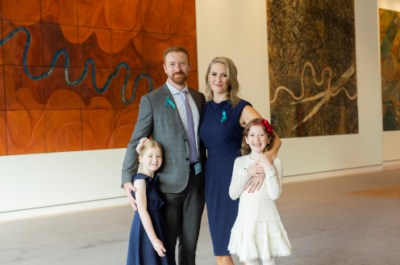
“I’ll never forget the look on the radiologists’ faces when I had my CT scan,” Caitlin said.
“I just knew it would be bad news. I remember sitting in the room before the scan thinking, almost knowing, that this wouldn’t be my last time, that this was the first of many appointments I would have in a long journey.”
Caitlin was correct. What she found out next would change her life forever.
“I was diagnosed in February 2017 with a rare form of ovarian cancera disease where abnormal cells split without control and spread to other nearby body tissue and/or organs. I was only 39 and my daughters had just turned two and four. For six months in the lead up I was experiencing a lot of fatiguea state of extreme tiredness or exhaustion, can be physical or mental and intense migraines. I felt dramatic as I thought I was dying. I just knew something was wrong,” Caitlin reflected.
Unfortunately, ovarian cancer is very difficult to diagnose, with symptoms often mirroring those of PMS or IBS. Most women, like Caitlin, are diagnosed at advancedat a late stage, far along stages, when the disease is harder to treat.
It was abdominal pains and changes in appetite that led to further investigations for Caitlin, with lesions on her liver revealing stage 3 ovarian cancer. This was soon categorised to stage 4 when doctors discovered the disease had spread through her diaphragm into the chest wall. However, like her diagnosisthe process of identifying a disease based on signs and symptoms, patient history and medical test results, Caitlin’s treatment was not straight forward.
“They initially told me that I had high gradea description of how abnormal cancer cells and tissue look under a microscope when compared to healthy cells serous ovarian cancer, the most common type, so I began standard treatment which included weekly chemotherapya cancer treatment that uses drugs to kill or slow the growth of cancer cells, while minimising damage to healthy cells, followed by complicated surgerytreatment involving removal of cancerous tissue and/or tumours and a margin of healthy tissue around it to reduce recurrence. I had a radical hysterectomycomplete or partial removal of the uterus, my spleen and liver stripped, and all tumours removed, including those in my diaphragm,” Caitlin shared.
But a post-surgery biopsyremoval of a section of tissue to analyse for cancer cells revealed that Caitlin actually had clear cell ovarian cancer, the rarest and deadliest of them all.
“Doctors said to me that the pathologythe study of disease didn’t matter, that ‘we treat all ovarian cancers the same’, which was alarming. My cancer wasn’t behaving typically like clear cell either, so despite results there was the possibility that I still had high grade serous ovarian cancer. To this day I believe my cancer is actually a mix of both,” Caitlin continued.
“I went along with the presumption that my pathology didn’t matter, but I was cautious, as I am a scientist by profession. I had also recently witnessed my mother in law pass away due to poor care, mainly owing to a lack of communicationHow we talk to each other; how we share our knowledge, what we know with each other. between health professionals.”
It was during this time that Caitlin learnt the importance of advocating for herself within a complex health system.
“I was lucky to receive world leading care at my holistic cancer hospital, where compassion is at the core of everything they do. This made a huge difference to my experience, and thankfully the surgery I had in May 2017, combined with six months of chemo, was a success. They were able to remove all of my visible disease. I then went on the maintenance treatment Avastin. As a stage 4 patient I was able to access it for free for one year, then I had to self-fund which cost $45,000 in my second year,” Caitlin said.
“It was working really well and I remained cancer free for two years whilst on Avastin. At the time there was no data on the efficacy of Avastin beyond two years, so I was advised to stop it. Six months later, in Feburary 2020, when COVID crashed into our lives, my cancer reoccurred. It came back in my liver and lymph nodessmall bean-shaped structures that filters harmful substances from lymph fluid. Chemotherapy didn’t work this time, which apparently is normal for clear cell ovarian cancer, but not what my team expected given my great initial response. This is when I was grateful to have pushed for genetic testinga procedure that analyses DNA to identify changes in genes, chromosomes and proteins, which can be used to analyse tumour DNA to help determine which treatment has the greatest chance of success as I was running out of options.
“I’m glad I did because these investigations revealed that the make-up of my cancer was extremely unique. It was confirmed that I do indeed have clear cell ovarian cancer. However, I also have genetic markers typical to high grade serous ovarian cancer.”
One clinical trial offered hope but was quickly deemed unsuccessful. Due to her rare pathology, Caitlin is not a candidate for many clinical trialsresearch studies performed to test new treatments, tests or procedures and evaluate their effectiveness on various diseases or PBS listed drugs which could prolong her life. Like all rare cancers, there are simply not enough people to warrant a trial, or to gather meaningful data, and by definition there never will be. But her clinical background and sheer determination drove her to keep advocating for herself, her life, and her family’s future.
“As a scientist, I knew I needed to find the most promising emerging science. I didn’t have time to wait for a suitable clinical trial and I didn’t want to go back on standard chemo that probably wouldn’t work. But even with my experience, I found I just couldn’t read scientific paper after paper. It was too close for me. It got overwhelming and stressful really quickly,” she said.
“So I reached out to the leading clear cell ovarian cancer experts in the world, including a specialist in Singapore. He recommended a new off label drug combo, not yet trialed in Australia, that had shown good results for endometrial cancer. He thought that with my cancer’s genetic structure it would benefit me, and it did.
“I started in July 2020 and I’ve remained stable ever since. None of my cancer has spread.”
This drug combo includes immunotherapya treatment that uses a person's immune system to fight cancer (Pembrolizumab), which Caitlin has every three weeks, combined with a daily treatment that comes in tablet form called Lenvatinib, a VEG-F inhibitor similar to Avastin. It has been working well to keep her cancer at bay, however the side effects are crippling.
“It has flared up my neuropathy, which is damage to my nerves from past chemo. This means I have difficulty walking and I’m in a lot of pain. Some days it feels like my feet have been burnt, especially as the skin is peeling off them,” Caitlin explained.
“But the treatment is working so I need to keep going. However, it is extremely expensive as it is not government funded, costing $12,000 a month. Cancer is crippling – physically and financially. It’s frustrating because other people can access PBS funded lifesaving drugs if they have a different kind of cancer or a more common pathology. But because mine is rare I have to pay and be my own clinical trial.”
Caitlin’s condition has recently progressed with two of the tumours in her liver growing.
“I was keen to have radiotherapy on my growing tumours. No one initially offered it to me as it’s not standard treatment for ovarian cancer patients in Australia. Overseas they use it a lot for clear cell ovarian patients, with good results. I pushed for the treatment and in May I received it. It’s still too early to tell if it has worked, but so far my tumours have not shown any more signs of growth,” Caitlin told.
“I’ve learnt a lot since having cancer, such as the importance of speaking up for yourself. Since being diagnosed I have advocated for better funding and awareness of ovarian cancer, for myself and all of those living with the disease. I even spoke at Parliament House to Scott Morrison earlier this year, pleading for more research funding and PBS listed drugs. But it upsets me that patients have to advocate so hard for themselves. It shouldn’t be that way.
“This experience has also opened my eyes up to how sensitive and vulnerable you are as a patient. I’ve worked in health as an IVF scientist for many years, but it wasn’t until I was a patient myself that I appreciated how different your experience can be to that of the experience your healthcare team think you’re having.
“For example, you don’t always hear or understand everything that people say when you are dealing with trauma. And words are so powerful. Depending on how and when you hear them, you can feel totally empowered or completely defeated. I don’t think that every member of the medical community appreciates the importance of good, patient-centric communication.”
This is the reason why Caitlin started the initiative CareFully.
“I launched CareFully last year to support and train healthcare professionals on the power of compassion, as well as to empower patients to advocate for themselves,” she shared.
Caitlin’s approach is unique in that she uses her dual insight as a both a health professional and patient to educate on the importance of compassion in healthcare, self-awareness, good communication, and patient-centred care.
“I love what I do. It gives me purpose and makes me feel like I can use my traumatic experience to create something good and help others,” she continued.
Caitlin is also doing well from a health perspective.
“I’m going pretty strong. It’s four and half years since my diagnosis and I’ve almost smashed the five year survival rate for ovarian cancer,” she said.
“I hate cancer. It’s always there and on everyone’s minds, including my young kids. It has taken over our lives, and I hate that everything can so quickly become about me.
“But I try and lead a pretty normal life for my family. While the future is uncertain and my daughters still ask me why I have cancer, I’m grateful that I’m still here to answer that question.
“What I want people to know from all of this is that there is hope, and it can be found in the places you least expect. Don’t be afraid to think outside the box.”